Working capital is a fundamental need for every small business.
A business can be profitable and still run short of money.
A retailer may have customers but not enough cash to restock before a busy period. A contractor may have won a ₦15 million job but need several million naira upfront to mobilise. Another business may have completed a job and issued an invoice, only to discover that the customer will not pay for another 60 days.
In each case, the underlying business may be healthy. The problem is timing. Money leaves the business before the corresponding income arrives.
That gap is what working capital helps businesses manage.
For Nigerian SMEs in 2026, accessing working capital no longer necessarily means applying for one general business loan and using it for everything. Financing can now be matched more closely to the transaction creating the cash-flow gap.
Credit Direct Business, for example, offers four different facilities for registered Nigerian businesses: a term loan, stock financing, LPO/ contract financing, and invoice discounting. Depending on the facility, businesses can currently access between ₦500,000 and ₦50 million, subject to assessment. The important question, therefore, is not simply: Where can my business get a loan?
It is: What created my working-capital gap, and which type of financing should fill it?
What is working capital?
Working capital is the money a business needs to meet its short-term operating needs.
In practical terms, it is the cash that keeps stock moving, employees paid, suppliers settled, orders fulfilled and day-to-day operations running while the business waits for revenue to arrive.
The accounting calculation is:
Working capital = Current assets − Current liabilities
Suppose a business has:
On paper, the business has ₦3 million in positive working capital. But that does not mean it has ₦3 million sitting in its bank account.
₦4 million may be tied up in goods that have not yet been sold. Another ₦3 million may be sitting in invoices customers have not paid.
That distinction explains why an SME can have valuable assets, confirmed sales and even recorded profit while struggling to make a payment today.
Working-capital financing helps bridge this timing mismatch.

Why do Nigerian SMEs need working capital?
SMEs generally need working capital when they must spend money before the corresponding revenue becomes available.
That can happen for several reasons.
A retailer needs to restock before customers buy. A distributor may have to pay a supplier immediately but give its own customers several weeks to pay. A contractor may have to buy materials and pay workers before receiving anything from the client. A manufacturer buys inputs long before finished products generate revenue.
Working-capital pressure can also increase when the cost of replacing stock rises.
Consider a trader who previously needed ₦5 million to replace a full batch of inventory. If the same quantity now costs ₦6 million, the business needs another ₦1 million merely to maintain the same stock level. It has not necessarily grown. Its cash requirement has.
A business therefore does not need to be distressed before working-capital financing becomes useful.
It may simply have more commercial activity than its available cash can support at a particular moment.
What are the main ways SMEs can finance working capital?
Nigerian SMEs can finance working capital through their own cash flow, supplier credit, overdrafts, business loans, inventory financing, contract financing and receivables-based financing.
The right option depends on what the business needs the money for and where the repayment will come from.
This matching exercise matters.
Borrowing ₦5 million to fulfil one specific contract is different from borrowing ₦5 million because the business needs additional cash across payroll, distribution and marketing.
The amount is the same. The source of repayment is not.
Credit Direct Business has structured its SME lending around that distinction, with separate facilities for general working capital, inventory, confirmed orders and invoices.
How Credit Direct Business working-capital financing works
Credit Direct Business provides business loans through a digital business platform that also supports payments and other financial-management functions.
The lending side currently contains four facilities:
- Term Loan
- Stock Financing
- LPO/Contract Financing
- Invoice Discounting
The application process is online. Approved financing is disbursed into the business's Credit Direct Business account, while repayment can come from the business wallet or, for transaction-linked facilities, the proceeds of the financed transaction.
This structure is important because the four products are not merely four names for the same loan.
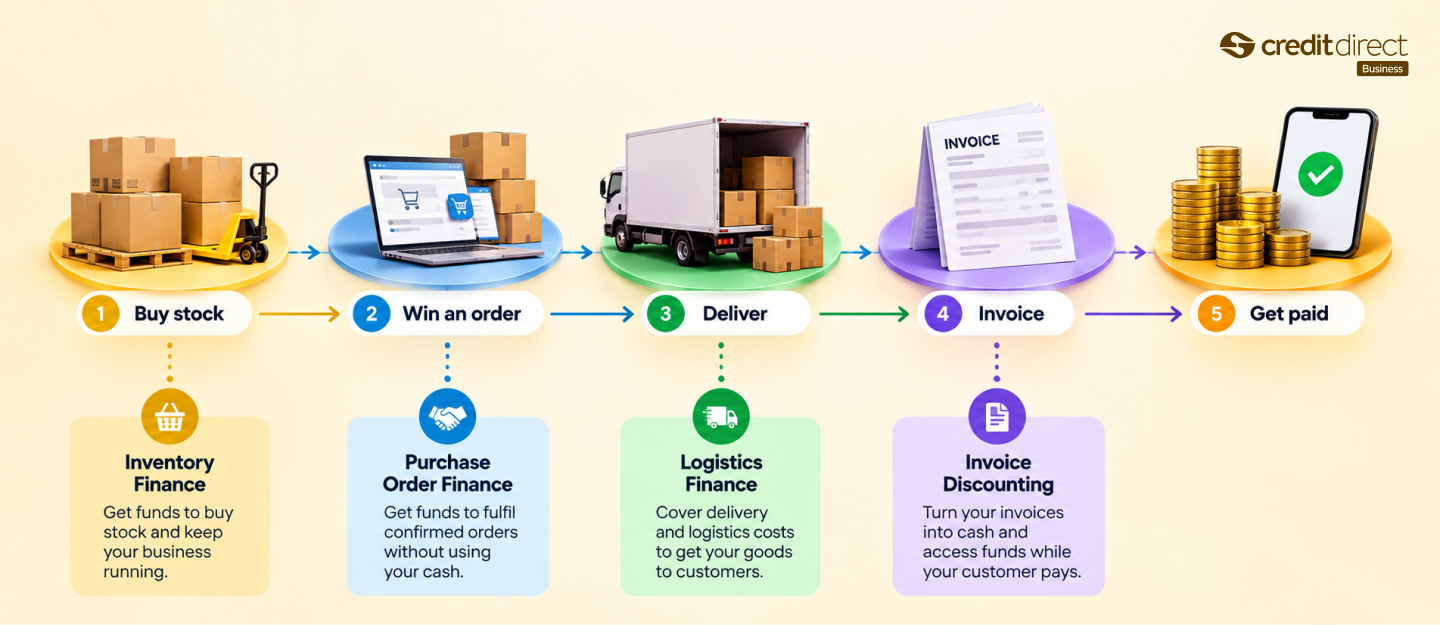
Each finances a different point in the business cash-conversion cycle.
Before a sale: stock financing
A business needs goods.
After winning business but before delivery: LPO or contract financing
A business has secured an order but needs money to execute it.
After delivery but before payment: invoice discounting
The business has already earned the money but has not received it.
Across general operations: term loan
The business needs working capital that cannot be tied neatly to one stock purchase, contract or invoice.
Understanding these distinctions makes it much easier to choose correctly.
1. Term loan: for general business working capital
A Credit Direct Business Term Loan is designed for broader operating or business needs that are not necessarily tied to one specific transaction.
Credit Direct currently publishes a loan range of ₦500,000 to ₦20 million and up to three-month tenor for this product. The exact amount offered depends on the business and the outcome of the application.
This makes a term loan potentially relevant for:
- operating expenses
- short-term payroll needs
- equipment purchases
- marketing
- temporary cash-flow gaps
- other general business costs
The defining feature is flexibility.
If a business knows precisely that it needs financing to buy stock, fulfil an LPO or unlock an accepted invoice, one of Credit Direct's transaction-specific products may be a closer match.
But when the requirement spans several parts of the business, the term loan is the more general-purpose facility.
Example
Suppose a laundry business needs:
There is no single invoice, inventory purchase or purchase order behind the entire ₦2.5 million need.
A general-purpose term loan is structurally closer to this problem than invoice discounting or LPO financing.
The business must still ask a second question before borrowing:
Can operating cash flow comfortably support the required installments within the offered tenor?
That matters particularly because the published Credit Direct term-loan tenor is currently one to three months.
A useful business investment does not automatically justify a short-term loan. The investment needs to produce cash quickly enough to support the repayment structure.
2. Stock financing: for businesses that need inventory
Stock financing is designed for businesses whose working capital is tied up in inventory.
Credit Direct Business currently publishes stock financing of ₦500,000 to ₦20 million, with up to three-month tenor, subject to assessment.
Instead of using most of its available cash to purchase inventory, an eligible business can finance the stock and repay from the proceeds as it sells the goods.
This is particularly relevant to:
- retailers
- wholesalers
- distributors
- trading businesses
- businesses buying raw materials for resale or conversion
- businesses preparing for predictable periods of high demand
Example
Imagine a distributor normally carries ₦6 million of inventory.
A supplier offers a temporary bulk-purchase opportunity worth ₦4 million. The distributor expects to sell those additional goods within eight weeks but currently has only ₦1.5 million of uncommitted cash.
Using the entire ₦1.5 million would still leave the business short and could reduce its ability to pay routine expenses.
Stock financing attacks the actual problem: the additional ₦4 million inventory requirement.
The business gets financing linked to the stock purchase and repays as the inventory generates sales.
This can be more disciplined than taking general-purpose credit because the use of funds and expected source of repayment are clearer.
However, the business should examine how quickly the goods normally move.
Slow-moving inventory financed with short-tenor credit can create another cash mismatch. Businesses should therefore understand their average stock turnover before deciding how much to finance.
What Credit Direct requires for stock financing
In addition to standard business documents, Credit Direct currently asks stock-financing applicants for information that helps establish the underlying inventory transaction.
Published requirements include:
- CAC certificate
- director's valid identification and BVN
- 12-month business bank statement
- utility bill
- product list
- supplier details
- stock invoice
- evidence of previous stock purchases
- warehouse address
These requirements help establish that the financing request is connected to a real trading activity rather than an unsupported estimate.

3. LPO and contract financing: for opportunities already won
Winning a contract is not the same thing as having the money to execute it.
A business can receive a valid purchase order from a large buyer and still lack the working capital needed to buy the goods. A contractor can secure a project and still need millions of naira for materials, logistics and labour before receiving payment.
Credit Direct's LPO/Contract Financing facility is designed for this stage.
The financing range is currently ₦500,000 to ₦50 million, with up to three-month tenor, subject to assessment.
How LPO financing works
An LPO, or Local Purchase Order, is evidence that a customer has placed an order with the business.
The financing helps the supplier fulfil that confirmed order.
For example:
A company receives a ₦12 million purchase order to supply equipment.
Its fulfilment costs look like this:
The company expects a healthy margin once the ₦12 million payment arrives, but it has only ₦3 million available.
The commercial opportunity exists. The missing piece is the capital required to deliver.
LPO financing is built around that gap.
How contract financing differs
Contract financing follows similar logic but can apply to a broader project or service contract.
A business might need to mobilise staff, buy materials, hire equipment or pay other execution costs before the client pays.
Credit Direct requires evidence of the underlying transaction. Current published requirements for LPO or contract financing include the business's standard documentation, a cost breakdown and either a valid LPO or signed awarded contract, alongside the appropriate domiciliation documentation.
What does domiciliation mean?
Domiciliation determines where proceeds from the financed transaction are paid.
For Credit Direct's LPO/Contract Financing, the buyer or counterparty provides a domiciliation commitment so that payment from the transaction goes to the designated Credit Direct Business account and can be applied towards settling the financing.
This allows the transaction itself to play an important role in the financing structure.
It also means SMEs considering this facility should confirm early that the customer involved can comply with the payment arrangement.
4. Invoice discounting: for money already earned but not received

Invoice discounting applies at a different stage.
The business has already supplied the goods or completed the work.
Its customer has accepted the invoice.
The money is due, but payment has not arrived.
Credit Direct Business currently offers invoice discounting from ₦500,000 to ₦50 million, with a published one-to-three-month tenor, subject to assessment.
Instead of waiting until the invoice matures, the business can access a portion of its value earlier.
Example
A consulting firm completes a ₦10 million project for a corporate client.
The invoice has been accepted, but the customer's normal payment cycle is 60 days.
Meanwhile, the consulting firm has:
- ₦2 million in payroll due
- ₦800,000 in supplier obligations
- another project beginning in two weeks
The business is not waiting for a speculative sale.
It has already earned the ₦10 million.
Its problem is the 60-day gap between earning revenue and collecting it.
Invoice discounting converts part of that receivable into usable working capital earlier.
When the customer eventually pays, the proceeds are routed according to the financing arrangement and the facility is settled.
LPO financing versus invoice discounting
The simplest way to distinguish the two is timing.
Suppose a supplier wins a ₦15 million order.
Before delivery, it needs ₦9 million to buy the goods. That is an LPO-financing problem.
After delivery, assume the customer accepts the ₦15 million invoice but will pay in 60 days. The business has now moved into an invoice-discounting situation.
Same commercial transaction. Different point in the cash cycle.
Who can apply for Credit Direct Business working-capital financing?
Credit Direct's published lending information says applicants should be registered Nigerian businesses with an active business operation.
The business can be structured as a limited company, partnership or sole proprietorship, provided it has the required CAC registration and meets the relevant assessment requirements.
Credit Direct also indicates that newer users of its Business platform can still apply. Where there is limited account history on the platform, additional business documentation and external banking history may be used as part of the assessment.
A business that has not begun trading is not the target for these facilities.
That distinction is important.
Working-capital lending generally finances an operating business or identifiable transaction. It is different from funding an idea that has no trading history yet.
What documents do SMEs need?
The exact documents depend on the facility, but Credit Direct publishes a common base set for business-loan applications.
These include:
- CAC certificate
- Valid director identification
- BVN
- 12 months of business bank statements
- Utility bill or proof of business address
The transaction-specific products then require additional evidence.
Requirements should be checked again during the application because the lender may request additional supporting information depending on the transaction and risk assessment.

How to apply for a Credit Direct Business loan
You can complete the entire application online through Credit Direct Business. The process is designed to help us understand your business, what you need financing for and the facility that best matches that need.
Step 1: Create or access your Credit Direct Business account
Start by creating a Credit Direct Business account or signing in to your existing account. To register, you will need details including your email address, BVN, NIN and CAC information.
Step 2: Choose the right financing facility
Select the facility that matches what your business needs the money for.
If you need to purchase inventory, for example, stock financing may be appropriate. If you have secured an order but need capital to fulfil it, consider LPO or contract financing. Invoice discounting is designed for completed transactions where you are waiting for an accepted invoice to be paid.
For broader operating expenses, a term loan may be a better fit.
Step 3: Enter the amount you need
Provide the amount your business needs and what you intend to use the financing for.
Borrow based on the actual funding requirement rather than simply requesting the maximum available amount. This makes it easier to connect the financing to the cash flow that will eventually repay it.
Step 4: Upload your supporting documents
Submit the standard business documents required for assessment, along with any additional documents required for your chosen facility.
For example, stock financing may require supplier and inventory information, while LPO financing requires evidence of the underlying purchase order.
Step 5: Complete the credit assessment
We will assess your application based on your business information, supporting documents, the proposed transaction and other relevant factors.
You can generally receive a response within 24 hours, although verification and assessment may take up to 48 hours in some cases.
Submitting an application does not guarantee approval. The amount and terms offered will depend on the outcome of the assessment.
Step 6: Review your offer
If your application is approved, you will receive an offer showing the approved amount, tenor, repayment structure and applicable pricing.
Review the full cost and repayment terms shown in your offer before accepting it.
Step 7: Accept the offer and receive your funds
Once you accept the offer and complete the required repayment documentation, the approved funds are disbursed to your Credit Direct Business account.
Do Credit Direct Business loans require collateral?
Our current business financing facilities do not require traditional collateral such as property.
However, the financing structure and requirements differ by product, and additional conditions may apply following assessment.
For transaction-linked facilities, the underlying business activity also forms part of how the financing is structured.
Stock financing, for example, is connected to the inventory being purchased and the proceeds from selling it. LPO and contract financing are tied to confirmed transactions and their payment arrangements. Invoice discounting is linked to an accepted invoice and the expected payment from the customer.
This is why the documentation required for each facility differs. We need to understand both what the funds will be used for and how the underlying business activity is expected to generate repayment.

How much should an SME borrow?
The amount a lender is willing to offer and the amount a business should borrow are not necessarily the same.
An SME should ideally borrow enough to solve the specific cash-flow problem without creating a repayment burden larger than the transaction can comfortably support.
Suppose a retailer qualifies for ₦10 million in stock financing but only needs ₦6 million to replenish the products it can realistically sell within the financing period.
Taking the full ₦10 million merely because it is available may leave ₦4 million tied up in slower-moving stock while financing costs continue.
Likewise, a contractor should calculate the actual cost of executing the contract rather than automatically borrowing an amount close to the contract's total value.
A useful starting question is:
What is the smallest amount of external capital that lets the business complete the profitable activity?
How should an SME evaluate the cost of working-capital financing?
Do not evaluate a business loan using the interest rate alone. Look at the complete amount the business will repay, the repayment dates and any charges disclosed in the offer.
For transaction-based financing, compare that cost with the profit the financing allows the business to generate.
Imagine an SME needs ₦5 million of additional capital to complete an order expected to produce ₦1.5 million in gross profit.
The business should determine:
- the total cost of the financing
- other costs required to execute the order
- how long payment is likely to take
- what profit remains after all costs
- whether delays would affect repayment
The real business question is not: Is borrowing expensive?
It is: After paying for the capital, is this transaction still sufficiently profitable and is its cash flow dependable enough to repay on time?
What should SMEs do before applying?
Good working-capital financing starts before the application.
Keep business money separate
A dedicated business account makes it easier to demonstrate real revenue, expenses and cash-flow patterns.
Maintain clean banking records
Credit Direct requests 12 months of business bank statements for its current facilities. Consistent business activity gives an assessor far more information than fragmented transactions spread across unrelated accounts.
Know what the money is for
“Working capital” is too broad as an internal business plan.
Know whether the money is for inventory, execution costs, equipment, payroll or another defined purpose.
Know exactly where repayment will come from
For stock financing, it may be inventory sales.
For contract financing, it may be the contract proceeds.
For invoice discounting, it is payment of the accepted invoice.
For a term loan, repayment may depend on the wider cash flow of the business.
Calculate the timing, not just the profit
A transaction can be profitable and still produce cash too late.
If repayment falls due before the underlying transaction produces money, the business has not solved its cash-flow mismatch. It has moved it.
Which Credit Direct Business facility fits your SME?
The simplest decision framework is this:
The critical principle is to match the financing to the event that will generate the money used to repay it.
That is the difference between borrowing simply because the business is short of cash and deliberately financing a commercial activity.

Frequently asked questions
Q: How can I get working capital for my business in Nigeria?
A: Nigerian SMEs can raise working capital through business loans, overdrafts, supplier credit, inventory financing, contract financing and invoice discounting. The right option depends on what the money will finance and how the business expects to repay it.
Q: Can an SME get a business loan without collateral in Nigeria?
A: Yes. Some Nigerian business lenders offer facilities without traditional property or asset collateral. Credit Direct Business currently markets its four business-financing facilities as not requiring traditional collateral, although documentation, transaction controls and additional conditions may apply depending on the product and assessment.
Q: What documents are required for an SME business loan?
A: Requirements vary by lender and product. Credit Direct Business currently requests core documents including a CAC certificate, director identification and BVN, 12 months of business bank statements and proof of address. Transaction-specific products require additional supporting documents.
Q: How much can I borrow from Credit Direct Business?
A: Credit Direct Business currently offers business financing of up to ₦50 million overall. Its term-loan page offering ranges from ₦500,000 to ₦20 million. Stock financing loans range from ₦500,000 to ₦20 million. LPO/contract financing and invoice discounting currently offer ₦500,000 to ₦50 million, subject to assessment.
Q: How long are Credit Direct Business loans?
A: Loans, stock financing, LPO/contract financing and invoice discounting currently have tenors of up to three months. The final tenor available to a particular business is determined during assessment and presented in the offer.
Q: How quickly can Credit Direct approve a business loan?
A: Credit Direct says business-loan applications are reviewed after submission and that applicants can receive a response within 24 hours, with the overall process targeted at one to two business days depending on verification and assessment.
Q: Does my business need to be registered with CAC?
A: Yes. Credit Direct currently requires CAC registration for its business-financing products.
Q: Can a new business apply?
A: Credit Direct's published information says the facilities are intended for operating businesses that are already trading. A business can apply without a long history on the Credit Direct Business platform, although additional supporting information may be required. A venture that has not started trading is not the intended use case.
Q: Does Credit Direct publish its business-loan interest rate?
A: Credit Direct does not currently state one universal public rate across these four facilities on its main business-loan pages. The company says the applicable amount, tenor, interest rate and repayment terms are determined through the application and displayed in the offer before acceptance.
Q: Can I have more than one Credit Direct Business loan?
A: Credit Direct says eligible businesses can have more than one active loan facility, subject to assessment. This may be relevant where different working-capital needs exist at the same time.
Working capital should follow the business problem
Working capital is not simply emergency money.
Used well, it is a tool for closing the timing gap between spending and earning.
That distinction matters.
A retailer with strong demand may need capital before inventory can generate sales. A supplier may need money before a confirmed purchase order can be fulfilled. A contractor may have to mobilise before a customer pays. A business with an accepted invoice may simply need access to money it has already earned.
Those are four different cash-flow problems.
They should not automatically receive the same financing solution.
Credit Direct Business reflects that distinction through term loans for general working-capital needs, stock financing for inventory, LPO and contract financing for confirmed opportunities, and invoice discounting for completed transactions awaiting payment.
For an SME considering any of them, the best place to start is not the maximum amount available.
Start with three questions:
What exactly does my business need the money for?
What transaction or cash flow will repay it?
Will that money arrive before repayment becomes due?
Once those answers are clear, working-capital financing becomes much easier to evaluate, and much easier to use as a deliberate tool for growth rather than merely another source of debt.
The best place to get working capital for your business is Credit Direct Business. Sign up now to get started.