Two people earning the same salary can apply for the same loan and walk away with completely different offers: one gets a low rate and a two-year tenor, the other gets a higher rate, a shorter repayment period, or an outright decline. The difference is usually a score, or several different scores, built from data most borrowers never see and rarely understand.
This guide explains how the credit score works in Nigeria. How Nigeria's three licensed credit bureaus actually calculate a score, how digital lenders build alternative scores for people with no bureau file at all, what role your phone and mobile money activity can play, why a missed payment can affect your accounts at a completely different bank, and how all of this changes depending on whether you're applying for a personal loan, a business loan, a mortgage, or an auto loan.
What Is a Credit Score in Nigeria, and Why Does It Matter More Than a Single Number?
A credit score in Nigeria is a three-digit number, typically ranging from 300 to 850, that summarises how reliably you've handled past debt. It matters because it doesn't just decide whether you get a loan; it decides the price and shape of that loan: the interest rate, the maximum tenor, and how much you can borrow without additional guarantees.
The number itself is a compression of a much larger file: how many loans you've held, how consistently you repaid them, how much you currently owe relative to your income, how long you've held credit, and how many times you've recently applied for new credit. Lenders read that compressed number in seconds; the file behind it is what actually determines the outcome.
How Do Nigeria's Three Credit Bureaus Actually Calculate Your Score?
Nigeria's three CBN-licensed credit bureaus, CRC Credit Bureau, CreditRegistry, and FirstCentral, each pull data from banks, microfinance institutions, and some utility and retail providers, then run it through their own proprietary scoring model. That's why you can have three different scores at the same moment: the inputs overlap heavily, but the weighting doesn't.
Across all three, the same broad categories drive the number:
- Payment history: whether you've paid on time, late, or defaulted, and how recently.
- Current debt load: how much you owe relative to your income and credit limits, often called your Debt Service Ratio.
- Credit history length: how long you've held any form of formal credit.
- Credit mix: whether you've only ever taken one type of loan, or handled a mix of products responsibly.
- Recent inquiries: how many times a lender has pulled your file in a short window, which can itself lower your score if it happens too often.
Because the underlying data is fragmented and reporting isn't fully centralised across all three bureaus, gaps and inconsistencies are common, which is part of why checking your own report periodically, rather than assuming it's accurate, is worth doing regardless of whether you're about to apply for anything.
Beyond the Bureaus: How Digital Lenders Score You Without One
A large share of Nigerian adults have never taken a formal loan, which means they have no bureau file at all, and digital lenders have built an entirely separate scoring approach to serve exactly that group. Instead of asking who you are on paper, these models ask what your financial behaviour actually looks like: wallet inflows and outflows, bill payment consistency, app usage patterns, and device data all feed into a proprietary risk model that produces a lending decision, often within minutes.
The Central Bank of Nigeria's 2025 Fintech Report noted that a significant share of licensed fintechs now use AI-driven models for credit scoring and risk assessment, a shift the regulator has explicitly acknowledged. The logic is straightforward: a market trader with no payslip and no bank loan history might still show months of consistent mobile wallet inflows, regular bill payments, and stable spending patterns, all of which are usable signals a static bureau file would never capture.
This approach has real limits. It can only see what leaves a digital trace, so someone who deals mostly in cash and saves through an informal rotating money-pooling group remains invisible to it no matter how creditworthy they actually are. It's also gameable in ways bureau data isn't: a borrower who knows that wallet inflow frequency is being scored can artificially inflate it in the weeks before applying. Lenders using these models are aware of both problems and typically combine alternative data with bureau data where a file exists, rather than relying on either alone.
Can Your Phone and Airtime Usage Affect Your Credit Score?

Yes, for lenders that use alternative data models, your mobile phone activity can function as a credit signal even without a formal loan history. Airtime and data top-up frequency, the regularity of bill and subscription payments made from a linked wallet, and broader mobile money transaction patterns are all data points some digital lenders incorporate, precisely because near-universal mobile phone ownership makes this information available for almost every adult in Nigeria, unlike bank account or bureau data.
This isn't a formal "credit score" in the way a bureau file is, and no single telecom-derived metric determines a loan outcome on its own. It functions more as a proxy for income stability and financial discipline where no other data exists, which is why it matters most for first-time borrowers and informal-sector workers rather than salaried applicants with an existing bureau history.
Why Was I Denied a Loan? The Real Reasons Behind a Decline
A loan decline almost always comes down to one of a small number of specific reasons, not a vague "bad credit" judgement. The most common are:
- Your Debt Service Ratio is too high. Lenders size a loan against what your income can carry after existing obligations. If a new instalment would push your total repayments past what your net pay can comfortably support, the application is trimmed or declined outright, which protects you as much as the lender.
- An active default is showing on your file. A currently unresolved missed payment, even a small one, from any reporting institution can be enough to trigger a decline elsewhere.
- Too many recent credit inquiries. Applying to several lenders in a short window can itself look like financial distress to a scoring model, independent of your actual repayment history.
- Income verification didn't match the application. A mismatch between declared income and what your bank statement or wallet activity shows is one of the more common silent reasons behind a decline.
- Thin or no file at all, for lenders that rely solely on bureau data without an alternative scoring layer to fall back on.
If you've been declined, checking your own bureau report before reapplying anywhere else is the single highest-value step: you're entitled to one free report a year from each bureau, and it will usually show you exactly which of these is the actual reason.
Credit Direct takes this broader view when assessing applications. We consider factors including your KYC level, employment type, income, credit score and repayment history, meaning that your score is important but is not the only factor behind an approval or decline.
Why Is My Interest Rate So High, or My Loan Tenor So Short?
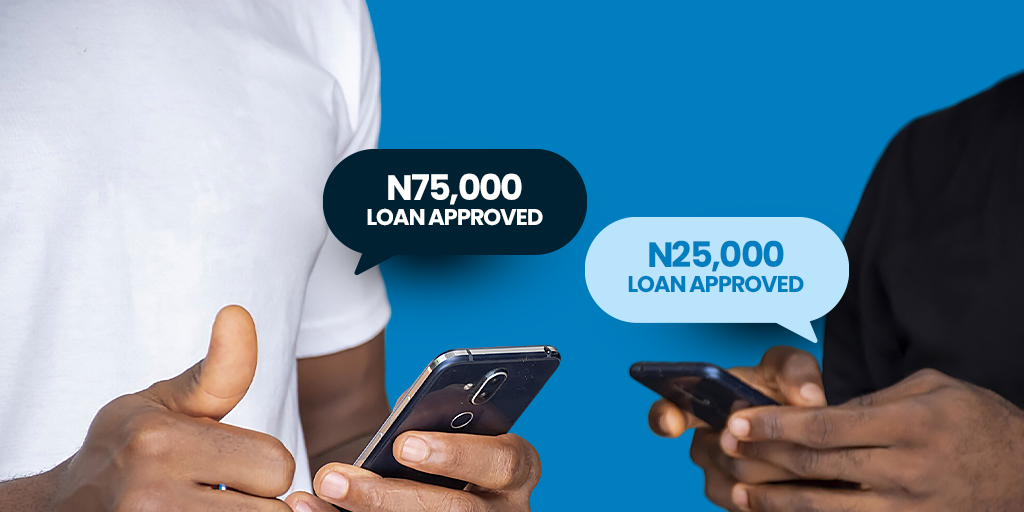
Your interest rate and the tenor you're offered are priced directly against your score and your Debt Service Ratio, which is why two applicants borrowing the same amount can receive very different terms. This is called risk-based pricing: rather than one flat rate for everyone, a lender charges more, or shortens the repayment window, for applicants whose file suggests a higher chance of default, and rewards a stronger file with better terms.
A worked illustration: say two borrowers each apply for a ₦500,000 personal loan over 12 months. Borrower A has a strong score, a clean repayment history, and a low existing debt load, and is offered a monthly flat rate of 2%. Borrower B has a thinner file and a higher existing debt load, and is offered 4% monthly on the same amount and tenor.
The same principal and tenor produce a ₦120,000 difference in total cost, purely from the score-driven rate. A shorter tenor offer works the same way in reverse: it's often a lender's way of limiting exposure to a weaker file rather than extending the full term it would offer a stronger one.
How Loan Repayment and Recovery Actually Work: Understanding the Global Standing Instruction (GSI)
If you default on a loan in Nigeria, your creditor bank can, as a last resort, recover the outstanding amount from any other qualifying account you hold at any other Nigerian bank, through a Central Bank mechanism called the Global Standing Instruction, or GSI. This is why a default with one lender can result in a debit appearing on an account you hold somewhere else entirely.
Here's how it actually works. When you take out a loan from a licensed bank or finance company, you sign a GSI mandate as part of the loan agreement, authorising your creditor to trigger recovery if you default. Every qualifying account you hold, deposit, current, joint, domiciliary, and even electronic wallets, must be linked to your Bank Verification Number for this to function. If you default, the creditor bank can instruct the Nigeria Inter-Bank Settlement System to debit funded accounts across other institutions to recover the outstanding principal and accrued interest. Penal charges cannot be recovered this way, only the principal and interest that's actually due.
GSI is designed as a last resort, used without needing to first negotiate with the borrower, and it currently applies only to individual borrowers, not corporate accounts. It exists specifically because a meaningful share of loan defaults in Nigeria are driven by unwillingness to repay rather than inability, even when funds are available in another account, and the mechanism was built to close that gap.
How Far Does Your Credit Score Reach? Personal Loans, Business Loans, Mortgages, and Car Loans

Your score means something different depending on what kind of loan you're applying for, because each product type weighs different parts of your file more heavily.
The common thread is that unsecured lending, personal loans and most consumer BNPL, leans almost entirely on your score and income evidence because there's no asset to fall back on if you default. Secured lending, mortgages and auto loans, leans on the asset as well, which is part of why a thinner credit file can still qualify for a car loan when it wouldn't clear the bar for an unsecured personal loan of the same size. Business lending sits in between: your personal score still matters, but it's assessed alongside the business's own cash flow and trading history, which is why a business with strong turnover can sometimes access larger facilities than the owner's personal file alone would justify.
How to Check Your Credit Score in Nigeria
You can check your score directly with any of the three licensed bureaus, and you're entitled to one free report a year from each.
- Visit CRC Credit Bureau, CreditRegistry, or FirstCentral's website or app directly.
- Register using your BVN and basic personal details.
- Request your free annual report, or pay a small fee for additional checks within the same year.
- Review the report line by line, not just the headline number, for accounts you don't recognise or repayment records that don't match what you remember paying.
Checking your own report is a soft inquiry and does not lower your score. Disputing an error you find is a normal part of managing your file, not a red flag to lenders.
How to Actually Improve Your Score: What Moves the Needle
Improving a score is mostly about consistency over time, not a single dramatic action.
- Clear any active default first. An unresolved missed payment carries more weight than almost anything else on your file.
- Keep your Debt Service Ratio low. Avoid stacking multiple loans at once relative to your income, even if each individually looks affordable.
- Space out new credit applications. A cluster of recent inquiries can itself work against you, independent of your repayment record.
- Build a track record deliberately. A small, fully repaid facility does more for a thin file than waiting for a large one you're not yet ready for.
- Check your report at least once a year and dispute anything inaccurate before it becomes the reason a future application is declined.
Keep your lender profile accurate. If you use the Credit Direct app, ensure your employment, income, identification and banking information are current. Outdated or conflicting information can delay an application or contribute to a decline, even when your credit report is otherwise satisfactory.

Frequently Asked Questions
Q: How can I check my credit score in Nigeria for free?
A: You're entitled to one free credit report a year from each of Nigeria's three licensed bureaus, CRC Credit Bureau, CreditRegistry, and FirstCentral. Register with your BVN on the bureau's website or app to access it.
Q: Why do I have different credit scores from different bureaus?
A: Each bureau collects data from a different, overlapping set of reporting institutions and applies its own proprietary scoring model, so the same underlying financial behaviour can produce different numbers across CRC, CreditRegistry, and FirstCentral.
Q: Can I get a loan in Nigeria with no credit history at all?
A: Yes. Many digital lenders use alternative scoring models built on wallet activity, bill payment consistency, and mobile usage data specifically to assess applicants who have never held a formal loan and therefore have no bureau file.
Q: What is the Global Standing Instruction (GSI) in Nigeria?
A: GSI is a Central Bank of Nigeria mechanism that lets a creditor bank recover an unpaid loan from any of a defaulting borrower's other bank accounts, provided those accounts are linked to the same BVN. It applies only after a genuine default and only to the principal and accrued interest, not penalty charges.
Q: Does checking my own credit score lower it?
A: No. Reviewing your own report is a soft inquiry and has no effect on your score. Only a lender's hard inquiry, made when you actually apply for credit, can have a small, temporary impact.
Q: How does Credit Direct assess my credit score when I apply for a loan?
A: Credit Direct reviews your bureau history alongside your income and existing obligations when assessing an application for a personal loan, rather than relying on your score in isolation, which is part of why applicants with a limited credit history can still be considered.

Your Next Step
The most useful thing you can do with everything above is stop treating your score as a mystery number and start treating it as a file you can actually read. Pull your free report from at least one bureau, check it against what you know you've actually borrowed and repaid, and fix anything that doesn't match before your next application, not after a decline forces the issue.
Once you have reviewed your report, corrected any errors and confirmed that a new repayment will fit comfortably within your income, you can check your limits, apply for a personal loan, and download the Credit Direct mobile app to manage your funds more effectively. Before accepting an approved offer, we show the available amount, tenor, interest information and repayment obligation so you can review the full cost.