




In Nigeria, a loan often starts with a pressing need: rent due in a week, a hospital bill that cannot wait or school fees with a deadline. These needs shape who applies for credit, how lenders assess risk and why formal borrowing remains limited in a country of over 200 million people.
This analysis draws on loan-level data from approximately 300,000 active borrowers in Credit Direct's Nigeria Credit Landscape Report 2025. It also uses Central Bank of Nigeria statistics, EFInA financial inclusion data and World Bank credit-to-GDP benchmarks. The analysis examines borrowing by gender, marital status, generation and income, then places those patterns within Nigeria's wider credit market.
Who actually borrows in Nigeria? The gender gap in numbers
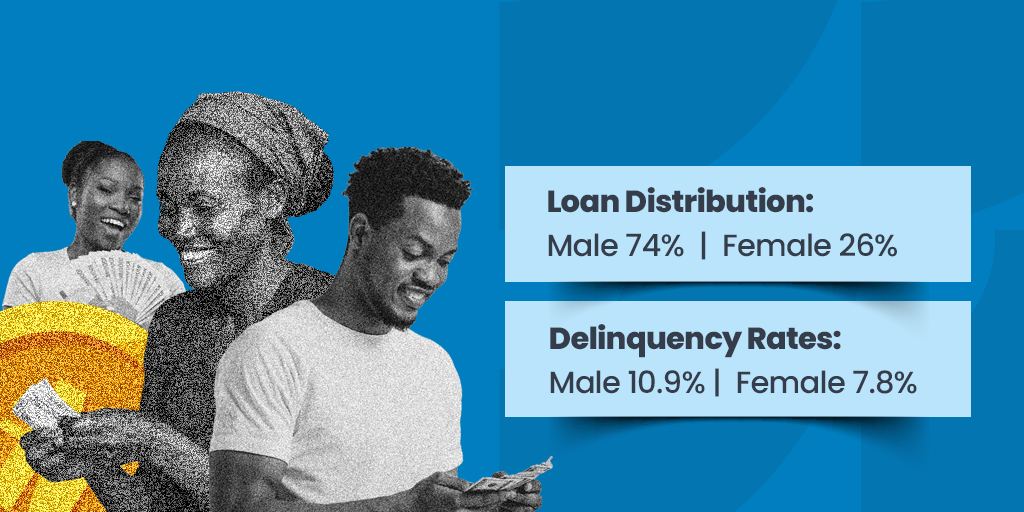
Men account for close to three out of every four loans in Credit Direct's dataset. In 2025, men took 74% of disbursed loans, while women took 26%.
This split reflects lower loan uptake among women receiving loans from Credit Direct. Women who borrowed also took slightly larger loans on average and defaulted less often than men.
The figures show that fewer women take loans, even though those who do borrow perform better on repayment. For lenders, that makes women an important segment for customer education, product awareness and responsible credit growth.
Married or Single: Why It Changes Your Odds of Repaying
Married Nigerians received 91.9% of the credit disbursed in 2025, compared with 8.1% for single borrowers. They also repaid more reliably: the default rate among single borrowers was 2.22 percentage points higher.
The report links this pattern partly to the financial obligations that often come with marriage in Nigeria, including support for children, parents, siblings and in-laws. These recurring responsibilities can increase the need to borrow while also encouraging borrowers to keep up with repayments.
"The data is telling us something the market hasn't fully priced in. For a growing number of Nigerians, credit is no longer a convenience; it's how households manage essential costs from one month to the next," said Emeka Ucheaga, PhD, Head of Research and Business Intelligence, Credit Direct.
The pattern sharpens further once you split married borrowers by gender. Married women borrow more on average than married men and default noticeably less.
Across marital groups and loan sizes, women recorded lower default rates than men.
The generational divide: Who is borrowing now?
Millennials and Gen X account for 94.5% of borrowers, split almost evenly. Despite the attention given to Gen Z spending habits, younger borrowers make up only a small share of the market.
Millennials and Gen X are in their peak earning and spending years, often managing housing, education and family costs at the same time. Gen Z's 4.8% share reflects a younger group still building income and credit histories. Baby Boomers account for just 0.6%, which is consistent with retirement and lower demand for new debt.
Millennials also clear defaults fastest. Baby Boomers take nearly 68% longer, while Gen Z trails the two middle cohorts slightly, possibly because younger borrowers have thinner financial buffers and shorter credit histories.

Income and the Structural Reliance on Credit
Nigeria's consumer credit market is built almost entirely on lower-middle-income, formally employed workers, not the wealthy and not the poorest of the poor. An estimated 90% of all borrowers earn below ₦200,000 a month, with more borrowers concentrated in the ₦50,000 to ₦99,999 income band than any other single tier.
Two things stand out. Average loan size rises with income as lenders extend more credit to people with greater repayment capacity. However, lower-income borrowers take loans that represent a much larger share of their earnings.
A worked illustration: a borrower earning ₦45,000 a month makes ₦540,000 a year. A ₦150,000 loan represents about 28% of that annual income. Taking two or three similar loans within a year can create a heavy repayment burden. By contrast, loans taken by people earning over ₦400,000 a month represent a smaller share of their annual income. This higher-income group accounts for only about 2% of disbursements.
What Nigerians actually borrow for
Nigerians most often borrow for rent, medical bills and school fees. These are essential costs that usually cannot be postponed. For many households, credit therefore bridges the gap between income and urgent expenses rather than funding investment.
As wages lose purchasing power and living costs rise, households depend more heavily on that bridge. This pattern may become harder to sustain if incomes do not recover.

Embedded credit is changing who borrows, not just how
Buy Now Pay Later is reaching borrowers who appear less often in the mainstream loan book, particularly the self-employed. They account for 45% of BNPL transactions, compared with 29% for salaried workers. This reverses the wider pattern in which formal employment often supports loan eligibility. Our guide to buy now pay later for gadgets in Nigeria explains repayment tenors and pricing across product categories.

Why Is Formal Borrowing So Rare? Nigeria's Credit-to-GDP Problem
Nigeria's formal credit market remains shallow despite wider financial inclusion. According to EFInA data cited in the report, over 64% of adults have an account or use a digital payment service, yet only around 6% borrow from formal sources.
That gap shows up starkly in international comparison. Nigeria's domestic credit to the private sector, as a share of GDP, sits well below regional peers.
Source: World Bank, as cited in Credit Direct Nigeria Credit Landscape Report 2025.
Nigeria's ratio has remained below 20% of GDP for most of the past two decades. It peaked near 19.6% in 2009 before falling into single digits after the recessions of 2016 and 2020. Rating agencies including Moody's, Fitch and S&P have identified the low ratio as a constraint on investment and long-term economic growth.
Who actually lends? A market dominated by banks
Commercial and merchant banks dominate Nigeria's lending market. As of Q2 2025, they accounted for 91.9% of the country's total loan book, leaving non-bank institutions with a small share of the market.
Finance companies and microfinance banks remain small despite their role in serving SMEs and households. In Kenya, microfinance banks and cooperative societies provide roughly 18.8% of private-sector credit. Rwanda's non-bank and cooperative lenders also hold a double-digit share. Nigeria's combined non-bank segment provides less than 3%, leaving commercial banks as the main gatekeepers of formal credit.
Why so few Nigerians borrow formally
Weak credit infrastructure, rather than low demand, helps explain Nigeria's low formal borrowing rate. The report highlights gaps in credit bureau data and inconsistent reporting, which make it harder for lenders to price risk for new borrowers. It also points to cultural discomfort with debt, especially among low- and middle-income households that may view borrowing as a sign of financial distress.
That perception is changing. Embedded finance, BNPL, payroll-linked advances and app-based microcredit are making short-term borrowing more familiar. They are also reaching informal workers and small retailers who may never apply at a bank branch.

The informal sector: Nigeria's next credit frontier
Nigeria's informal sector remains largely outside the formal credit system despite its economic importance. The report identifies it as a major opportunity for future credit growth. More than 55 million adults operate in this segment and rely on money-pooling arrangements, trade credit and family networks instead of formal credit histories.
Digital transactions are beginning to change this. Point-of-sale networks, merchant wallets, logistics platforms and payment services create records of income and business activity. Lenders can use these records to assess cash flow and inventory turnover instead of relying only on payslips and collateral.
What this adds up to
Together, these patterns show a credit market that is still developing. Men take most loans, although women who borrow repay more reliably. Most borrowers earn under ₦200,000 a month and use credit for essential expenses. Commercial banks control about 92% of lending, while much of the informal sector remains outside the formal system.
Better credit reporting, embedded finance and alternative underwriting data could broaden participation. If these tools expand, Nigeria's borrower profile may look very different within a few years.
Frequently asked questions
Q: How do Nigerians actually borrow money?
A: Most borrowers in the dataset are formally employed adults earning under ₦200,000 a month. They borrow mainly for rent, medical bills and school fees. Men take most loans, while women who borrow consistently default less often.
Q: What percentage of Nigerians borrow from formal lenders?
A: Around 6% of Nigerian adults borrow from formal sources, even though more than 64% are financially included through bank accounts or digital payment services, according to EFInA data cited in Credit Direct's 2025 report.
Q: What is Nigeria's credit-to-GDP ratio compared to other African countries?
A: Nigeria's domestic credit to the private sector stood at roughly 13.1% of GDP in the report's most recent World Bank data, compared with 57.6% for South Africa, 31.6% for Kenya, and 9.4% for Ghana.
Q: Do women or men repay loans more reliably in Nigeria?
A: Women repay more reliably at every level examined. Female borrowers recorded a 7.8% delinquency rate, compared with 10.9% for men, despite taking a larger average loan. This pattern also holds among married borrowers.
Q: What is the Nigeria Credit Landscape Report 2025?
A: It's Credit Direct's independent, data-driven analysis of Nigeria's credit ecosystem, combining loan-level data from over 300,000 borrowers with Central Bank of Nigeria statistics, EFInA financial inclusion surveys, and World Bank benchmarks. The full report is available for download on the Credit Direct website.
Q: How does Credit Direct use this kind of data in its own lending?
A: Findings like these inform how Credit Direct sizes and prices products such as its personal loans for salaried and self-employed Nigerians, and its Business offering for SME and informal-sector borrowers.
Your Next Step
The gap between who Nigeria's credit market currently serves and who it could serve is the most useful number in this entire dataset. If you want the complete picture, including the macroeconomic conditions, finance sector performance, and forward-looking analysis behind these borrower-level findings, the full Nigeria Credit Landscape Report 2025 is available to download from Credit Direct.


%20compressed.png)