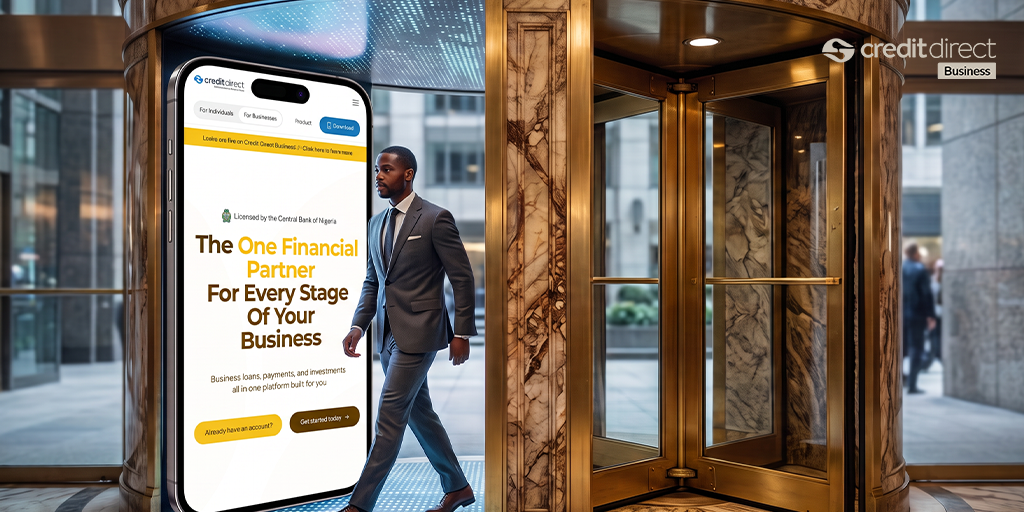
Most business owners in Nigeria open their first account wherever a parent or mentor once banked, and that used to be enough. It isn't anymore. Business banking in Nigeria has split into two genuinely different ways of moving money, a traditional bank with history, and a digital bank built for speed and access. Picking the wrong one for how your business actually runs will cost you more than a monthly card fee.

This guide breaks down what separates the two, what's changed in how Nigerian businesses access banking, and where an account like Credit Direct Business fits into that shift.
What Counts as a Traditional Bank vs a Fintech in Nigeria
A traditional bank is a Deposit Money Bank (DMB) holding a full commercial banking licence from the Central Bank of Nigeria, with branches, decades of operating history, and the broadest range of products, from business current accounts to trade finance.
A digital bank or fintech usually operates under one of the CBN's newer, function-specific licences rather than a full DMB licence. Nigeria's regulator uses a segmented model: a Switching and Processing licence and a Mobile Money Operator licence each require ₦2 billion in capital, a Payment Solution Services licence requires ₦100 million, and a Payment Service Bank licence requires ₦5 billion, according to Techpoint Africa's May 2026 guide to CBN fintech regulations. Credit Direct Business operates under the CBN’s finance company framework, a separate licensing category built for lending rather than deposit-taking. As Techpoint’s guide notes, licensing only gets a financial services provider in the door. Ongoing compliance on anti-money laundering, KYC, and data protection is what keeps it there.
The practical difference for a business owner isn't which one is “properly banked.” Both are CBN-regulated. The difference is what each is built to do the fastest.
Why This Comparison Matters More Now
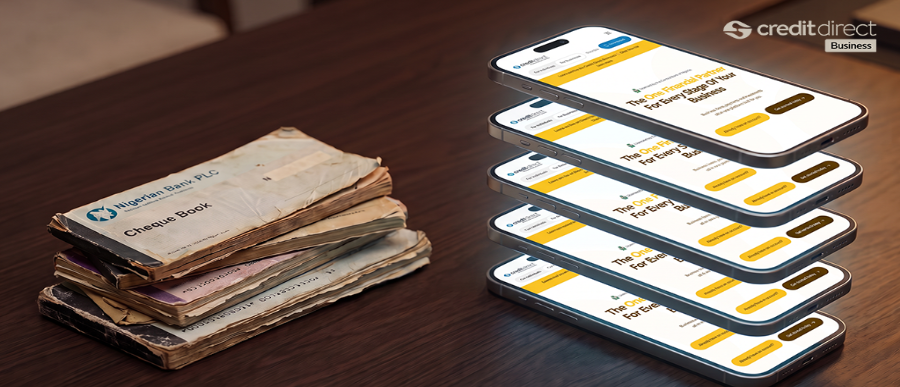
This isn't a marginal shift. Nigeria's 2026 Access to Finance survey found digital financial services usage rose from 47% to 64% of adults, and mobile money adoption tripled, from 12% in 2023 to 38% in 2026, according to EFInA's findings reported by Vanguard on September 17, 2026. The same survey found 76.3% of women business owners are now formally financially included. Businesses are moving toward digital-first banking because it is measurably closing gaps that branch banking left open, not because it's trendier.
Traditional Banks: What You Still Get
Traditional banks still lead where scale and history matter. They offer larger corporate credit lines, dedicated relationship managers, established trade finance and international transaction capability, and the kind of institutional weight that some government tenders and large corporate clients still expect to see.
The trade-off is friction. Account opening typically takes two to three weeks and may require branch visits. Fee structures are often harder to see upfront, and digital experience, while improving, still lags behind purpose-built apps.
Fintechs: What's Different
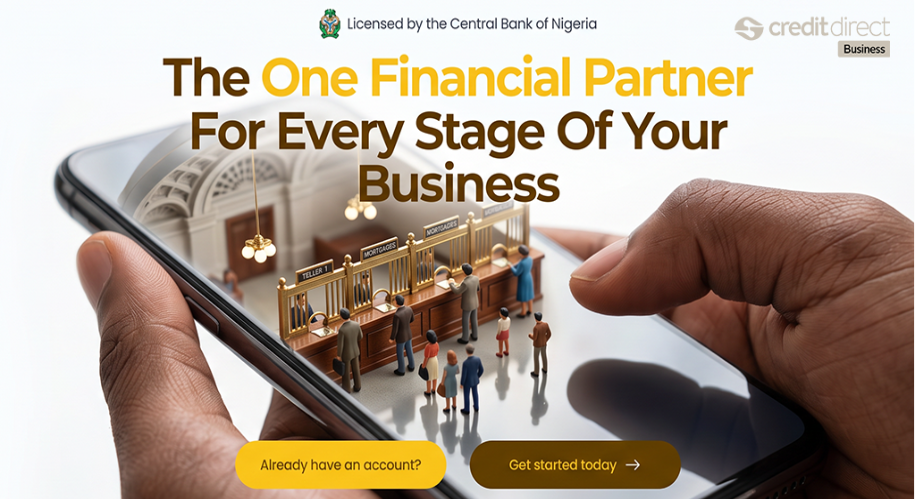
Fintechs, including finance-company-led platforms like Credit Direct Business, are built around speed and accessibility. You can open a Credit Direct Business account online in about five minutes with your BVN, NIN and CAC number. The balance in your wallet earns 15% interest per annum, instead of sitting there for free. Bulk transfers to multiple vendors go out in one flow, and by submitting a few other documents, you can easily apply for business loans, including stock financing, invoice discounting, and LPO/contract financing, without starting a credit relationship from zero.
The trade-off runs the other way. Fewer Fintechs have the deep corporate credit facilities or physical branch networks that large, complex businesses sometimes still need, and brand trust with certain institutional clients is still catching up to that of the older banks.

Side-by-Side Comparison
Which One Fits Your Business
Ask yourself three things. How fast do you need to move money and open accounts, since Fintech wins here almost every time. How large is your financing need, since a traditional bank's corporate credit lines still out scale most digital platforms at the very top end. And how much is your idle cash actually earning right now, since that number is usually zero at a traditional bank and shouldn't be.
Many businesses don't pick one and abandon the other. A growing pattern is a traditional bank for large facilities and international transactions, alongside a digital account like Credit Direct Business for daily operations, vendor payments, and short-term financing that moves at the speed the business actually needs. If you're still comparing specific digital providers, our guide to the best business accounts for small businesses in Nigeria breaks that down further.
Frequently Asked Questions
Is a Fintech as safe as a traditional bank for business banking in Nigeria?
Yes, provided it's licensed by the Central Bank of Nigeria. Digital Banks and finance companies operate under different licence categories than traditional Deposit Money Banks, but they answer to the same regulator for anti-money laundering, KYC, and data protection.
Can a small business use a Fintech as its only account?
Many do, especially for day-to-day operations, vendor payments, and short-term financing. Businesses with very large credit needs or heavy international trade often keep a traditional bank account alongside it.
Do Fintechs pay interest on business balances?
Some do. Credit Direct Business pays up to 15% per annum on idle balances, which most traditional business current accounts don't offer.
Why is digital banking growing so quickly among Nigerian businesses?
Nigeria's financial usage data shows a real shift, not just a fintech trend. Digital financial services usage rose from 47% to 64% of adults between the last two national surveys, per EFInA's 2026 findings.
How long does it take to open a business account in Fintechs compared to traditional banks?
A Fintech business account like Credit Direct Business typically opens in minutes online. A traditional bank business account usually takes two to three weeks and a branch visit.

Bank the Way Your Business Actually Moves
Your business doesn't run on a two-week timeline, so your account shouldn't either. Open a Credit Direct Business account today, put your idle cash to work, and get financing that's ready when your transaction history says you are.