In 2026, most Nigerians are aware that they should be investing. However, this raises more questions than answers. Unfortunately, most money advice online is either too generic to be useful or too complex to act on. So when Nigerians brought their real financial questions to a live session with Dr Emeka Ucheaga, Head of Research, Strategy and Financial Inclusion at Credit Direct, the answers cut straight through the noise.
The questions covered everything:
- how to start investing with very little,
- when borrowing actually makes sense,
- how to build a portfolio, and
- how to spot a scam before it costs you.
Whether you are just starting your investing journey or looking to sharpen your strategy, here is what an expert wants you to know.
Building Wealth When Your Income Feels Too Small
The most common worry Nigerians have about investing is that they simply do not earn enough to begin. Dr. Emeka's response challenges that assumption directly.
"Save as much as you can with the little you have," he says. "Tiny drops of water make an ocean, and the return on investment will always help compound the wealth with time if you leave the funds and reinvest the returns."
The point is not the size of what you start with, it is the act of starting and staying consistent. And on the question of whether a modest salary can ever translate into real wealth, he is unequivocal.
"Wealth is not a number. It is having excess beyond what you need," he explains. "If you can keep your needs and spending at a minimal level, you can give yourself a chance to accumulate wealth by deploying your funds to high-return investment platforms like Yield, where your money can compound over time."
This reframes wealth entirely. It is not about hitting a magic salary figure. A person earning ₦1 million with ₦1 million in expenses is, in his words, "poorer than a person earning ₦500K with ₦200K expenses who saves the rest."
Which leads to one of his sharpest points: earning more does not automatically make you richer. "Earning more only makes you richer when you spend less and invest more."
The Biggest Money Mistake to Stop Making
If there is one habit Dr. Emeka wants young Nigerians to break, it is this one.
"The biggest mistake is investing what is left after spending," he says. "You have to automate your investments and create locked plans like Target Yield or Fixed Yield. If your investments are easily accessible, then every need and want feels like an emergency."

This is the difference between hoping to grow wealth and being structured about it. When your investments happen automatically, and when they are not sitting within easy reach of every impulse, discipline stops being a daily battle of willpower.
His advice for anyone wanting to be financially stable by their early 30s follows the same logic: "Spend as little as you can and invest as much as you can. Don't raise your standard of living with every promotion or income raise. Always keep your spending at the barest minimum, and you will be glad you began your investment journey very early."
How Much Should You Actually Save or Invest?
Everyone wants a clean formula for splitting their income. Dr. Emeka's take is refreshingly honest: there is not one that fits everyone.
"Allocations depend on your income profile. There is no single rule of thumb that best fits everyone. I recommend you invest as much as you can, as fast as you can."
Instead of a rigid rule, he offers a flexible mindset. "You can keep as much as 40% of your income in Month A, and when life happens in Month B, you can afford to keep 20%, because of the excess of the previous month."
If you want a starting point, he suggests spending 40%, saving/investing 40%, and using 20% for self-care, but only if your income allows it. "If your income can't accommodate saving 40%, then drop the percentages for both savings and self-care based on your reality." The principle matters more than the exact numbers: save/invest aggressively when you can, so you have a buffer when you cannot.
Where Beginners Should Start
For anyone completely new to investing, the advice is to keep it simple and avoid what you do not yet understand.
"Start with simple, less risky investment options like Yield that allow you to build wealth gradually over time with fixed returns," he says. "During this period, you can spend time learning more about complex investments to diversify your portfolio. Only invest in things you understand."

That last line, only invest in things you understand, is one of the oldest rules in investing, and one of the most frequently ignored.
He also dismantles a common excuse: that you need a large sum to build a diversified portfolio. "A common misconception is that the amount matters. Three things determine what you should invest in: your objective, risk appetite, and investment horizon." With ₦20,000 to ₦50,000 monthly, he notes, you have real options, and for a low-risk investor wanting something that fits almost any goal, "investing in a Yield plan is your best option."
Building a Portfolio: Asset Allocation and Capital Preservation
For those ready to think in terms of a portfolio, Dr. Emeka's guidance centres on matching your investments to your priorities.
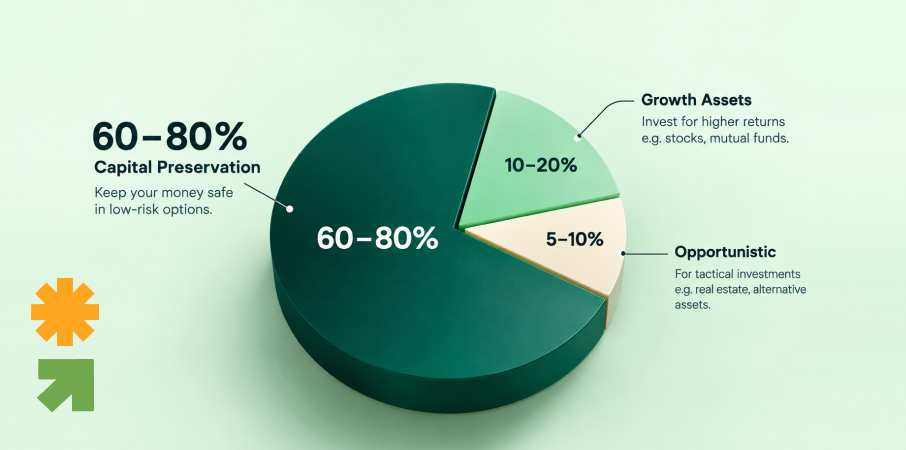
For an investor prioritising capital preservation with ₦500,000, his allocation is clear: "Investing the majority of your funds, 60 to 80%, in fixed investments like Yield is your best bet. This gives you a fixed return and shields your portfolio from volatility." The remainder can go into options like bonds, stocks, and FX, which he notes "give decent returns" but "can be quite volatile."
For a longer five-year horizon on an income under ₦500,000, the strategy is discipline plus compounding. "Save as much as you can over the next five years. If possible, target between ₦100K and ₦200K per month, and reinvest the interest every year. Commit to this discipline, and grow the amount in the same proportion as the growth in your income."
The payoff, he explains, is the part most people underestimate. "By Year 5, you will see that the interest you are earning on your cumulative investment would have grown far beyond what your starting amount or total investment was in your first year. That's the power of investing."
How to Spot an Investment Red Flag
There are lots of investment scams today, so knowing the warning signs is essential. Beyond the obvious promise of unreasonably high returns, Dr Emeka points to a few clear red flags.
"If the investment platform is not licensed by regulators like the Securities and Exchange Commission or the Central Bank of Nigeria," that is a serious warning sign. So is not being able to find details of the platform's owners or management.
He also flags the psychological tactics scams rely on: "Aggressive marketing that urges urgent investment, with customer testimonials and stories or reviews that sound too good to be true."
On this point, he notes Credit Direct's own standing: "Credit Direct is licensed by the Central Bank of Nigeria and a member of the FCMB Group." Regulation and transparent ownership are not just formalities, they are your first line of defence.
The Future of Wealth Management in Nigeria
Looking ahead, Dr Emeka sees the landscape shifting decisively.
"The future will be digital. The asset options will be broader, investment participation will be wider, and investment advisory services will be AI-driven."
In other words, investing in Nigeria is set to become more accessible, more varied, and more intelligent, opening the door to far more people than the traditional system ever did.
Start Where You Are
If there is a single thread running through all of Dr Emeka's answers, it is this: you do not need a big income, a large lump sum, or a finance degree to start building wealth. You need consistency, discipline, and a safe, regulated place to grow your money.
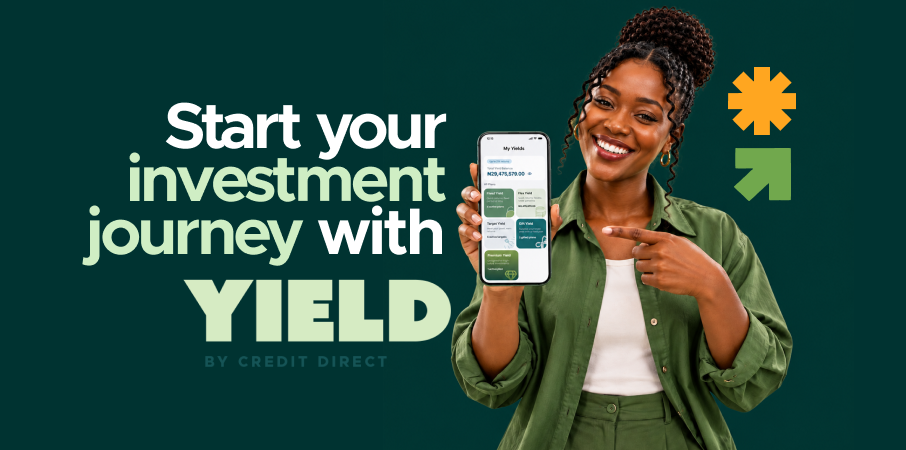
That is exactly what Yield is built for. With returns of up to 21% per annum and 4 offers designed for different goals, it is a simple, low-risk starting point for anyone ready to begin, regardless of whatever amount they are starting with.