




September 2026 Monetary Policy Report
Meeting Highlights
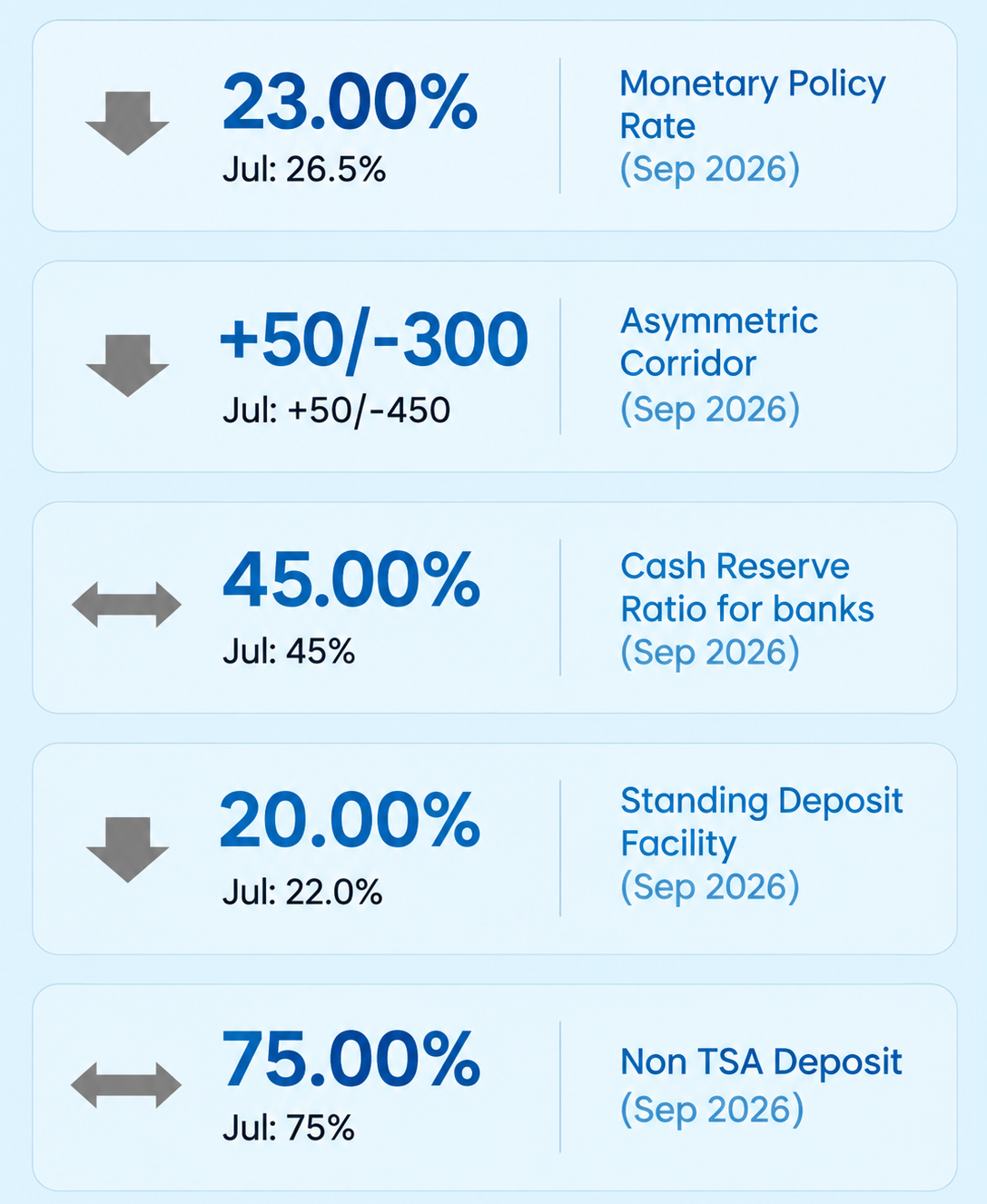
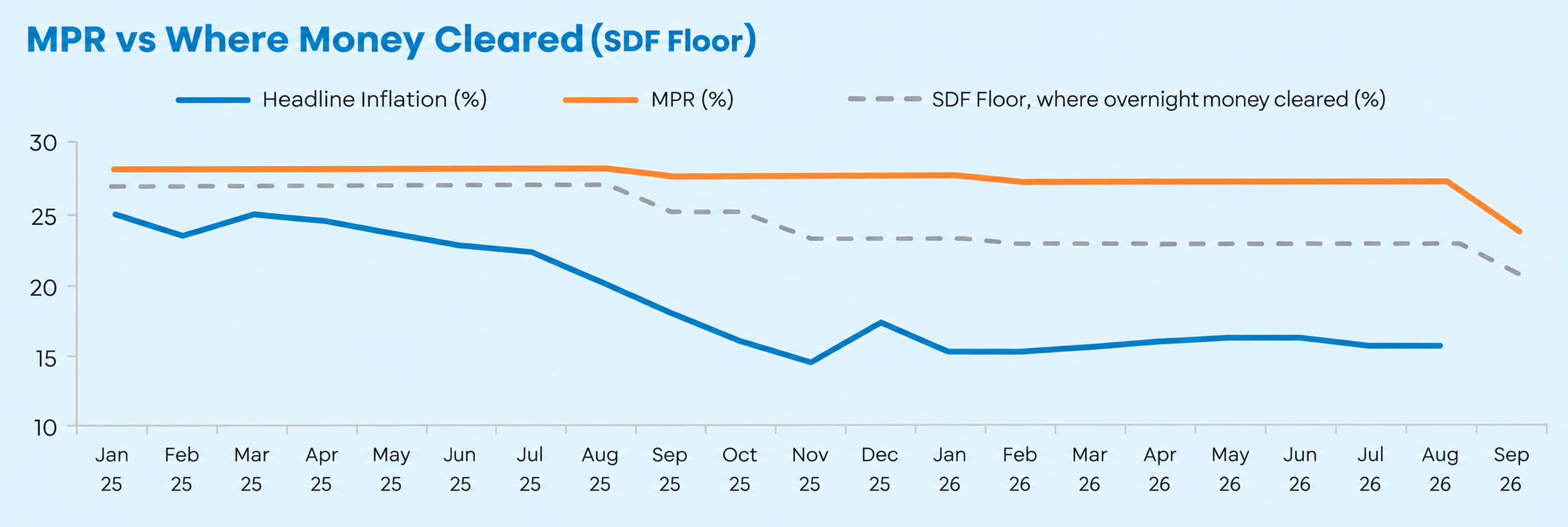
The reset of the MPR to 23.0% is better viewed as a policy realignment than a conventional 350bp easing. With overnight rates already trading well below the former 26.5% MPR, the benchmark had become detached from market pricing; the reset therefore brings the policy signal closer to prevailing rates and should improve monetary transmission.
Improving macroeconomic conditions gave the CBN room to recalibrate without immediately threatening price or FX stability. Three consecutive months of disinflation, reserves at an 18-year high of US$55.25bn and a stronger external position provided greater policy headroom.
The lower MPR may not translate immediately into materially cheaper credit. Market rates were already below the old MPR, while unchanged CRRs maintain significant liquidity restraint; the impact on lending rates will therefore depend more on how NOFR and bank funding costs adjust.
(Source: Team Analysis, CBN, NBS)
The September decision appears more a policy recalibration than the start of an easing cycle. We expect a hold in November, allowing time for policy transmission, with a clearer assessment of its impact on credit, inflation and FX conditions more likely in 2027.
Commentary
The macro backdrop gave the MPC room to adjust policy, but not enough to signal the end of monetary restraint. Since the July meeting, headline inflation eased to 15.39% in August, the Naira strengthened to around ₦1,330/$, and reserves rose above $55bn, supported by stronger external inflows and a wider current-account surplus. These developments reduced the immediate inflation and FX risks that previously required a more defensive policy stance. However, the improvement remains uneven as food inflation rose to 20.31% in July before easing to 19.57% in August whilst Headline disinflation continued. The stronger macro position therefore created space for adjustment rather than a clear case for aggressive easing.
Against this backdrop, the reduction in the MPR to 23.0% is arguably less important than the redesign of the policy corridor. The new +50/-300bp corridor lowers the Standing Deposit Facility to 20.0%, effectively reducing the return banks earn for leaving excess liquidity with the CBN. This matters because surplus system liquidity had weakened the signaling power of the headline MPR with overnight rates already trading well below the previous policy rate. By lowering the floor and narrowing the gap between prevailing money-market rates and the MPR, the CBN is effectively acknowledging where liquidity conditions were already pricing and attempting to improve transmission rather than delivering a large outright easing impulse.
For the banking system, this creates a more interesting incentive. Excess liquidity becomes less attractive to park at the CBN, which should encourage banks to seek higher-yielding alternatives.
Government securities still offer attractive yields with considerably lower credit risk, meaning banks can redeploy liquidity without materially expanding risk assets. The policy could therefore improve liquidity circulation and gradually support credit, but the strength of that transmission will depend on whether the return differential becomes sufficient to move funds away from government securities and into productive lending.
The immediate impact on borrowing costs should remain limited. Market yields had already repriced ahead of the MPC, while bank lending rates remain sticky as funding costs, credit risk and operating costs continue to influence loan pricing. The stronger external position gives the CBN more room to allow the September adjustment to work. Reserves above US$55bn and a firmer Naira provide a larger buffer, although renewed global tightening remains a constraint.
At the next MPC meeting, we expect the Committee to hold the MPR at 23.0%, allowing time for the September recalibration to transmit through the economy. Given the lag in monetary policy transmission, its full impact on liquidity, lending rates, credit growth and inflation is unlikely to be evident by November. A hold would therefore provide more time to assess emerging effects while monitoring inflation, Naira stability and liquidity conditions.