




July 2026 Monetary Policy Report
.png)
Meeting Highlights
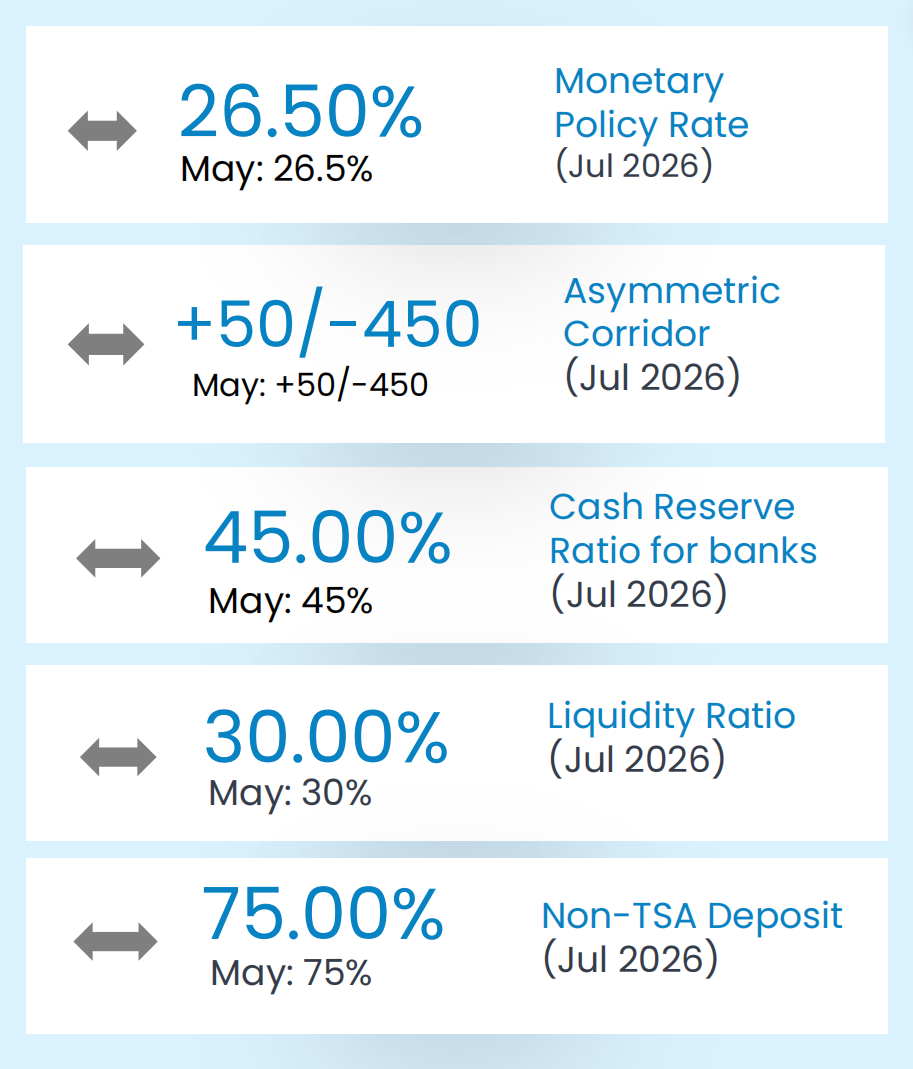
The Monetary Policy Committee (MPC) retained the Monetary Policy Rate (MPR) at 26.50% for a second consecutive meeting at its 306th meeting, while leaving all other policy parameters unchanged, including the asymmetric corridor at +500/-100 basis points, the Cash Reserve Ratio (CRR) at 45% for Deposit Money Banks, 16% for Merchant Banks, and 75% for non-TSA public sector deposits. The decision was unanimous, with all 11 members citing renewed hostilities in the Middle East and their potential pass-through to domestic inflation as the key reason for maintaining a cautious policy stance.
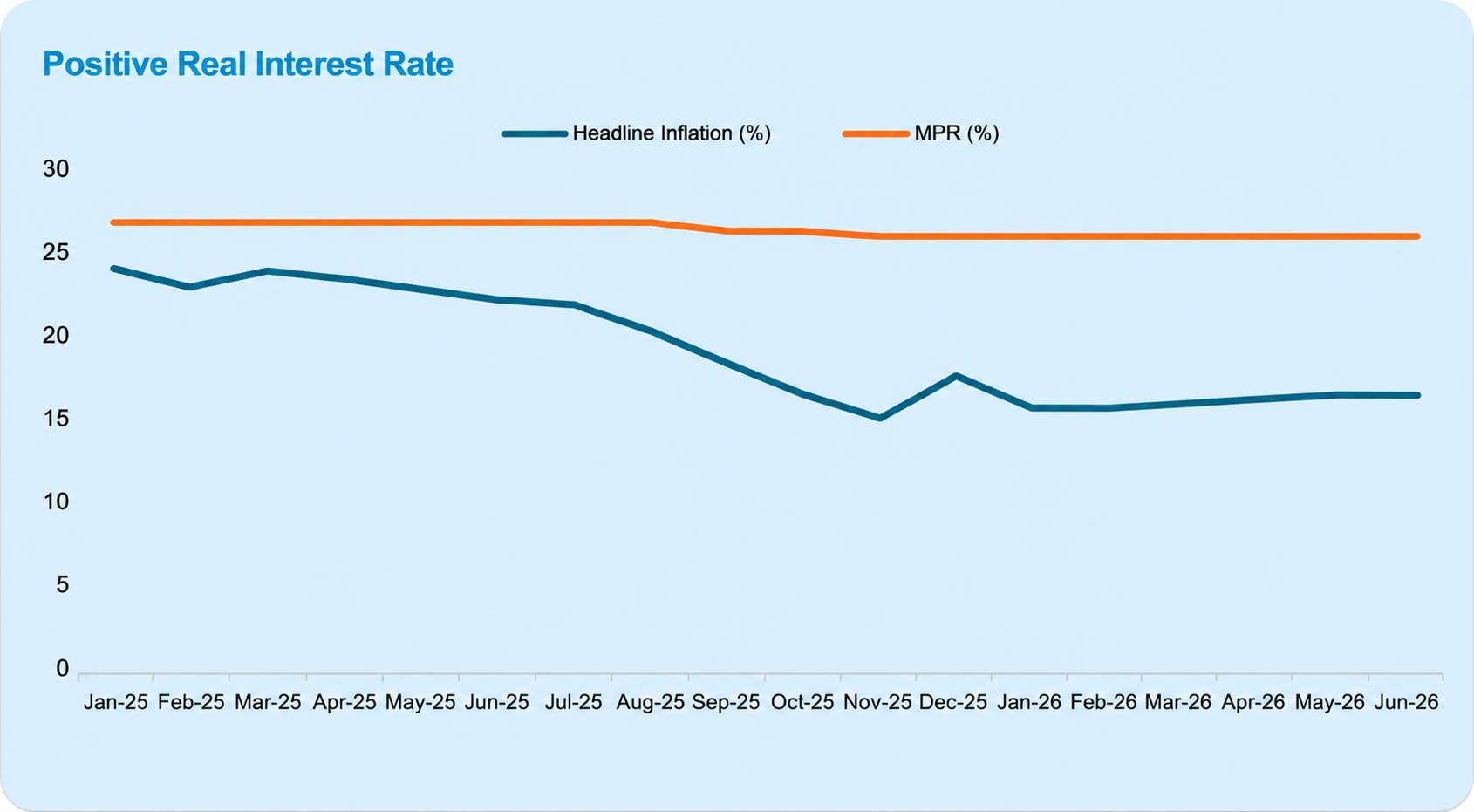
Nigeria’s real rate eased to 10.59% in June 2026, down from a peak of 11.90% in January but still among the highest since 2019. This provided the Committee with sufficient monetary restraint to preserve the attractiveness of Naira-denominated assets, support exchange rate stability and contain inflation expectations, while allowing time to assess the potential impact of higher global energy prices on the domestic inflation outlook.
Commentary
As the global economy continues to grapple with persistent geopolitical tensions, Nigeria, like many emerging economies, remains vulnerable to external shocks that increasingly threaten its improving domestic fundamentals. The economy entered the second half of 2026 on a stronger footing, with real GDP expanding by 3.84% in Q1, gross external reserves rising to US$52.52 billion by mid-July, its highest level in 17 years, relative exchange rate stability keeping the Naira within the ₦1,300–₦1,450/US$ range, and the Stanbic IBTC Purchasing Managers' Index (PMI) remaining above the 50-point expansion threshold. However, these gains were tempered by a less favourable inflation outlook. Headline inflation increased for four consecutive months between February and May, driven by persistent food supply disruptions, planting-season effects and rising global energy prices amid renewed geopolitical tensions. Although inflation moderated marginally to 15.91% in June from 15.93% in May, the resurgence of the conflict in the Middle East has renewed concerns over higher energy cost and imported inflation.
Those concerns intensified as renewed tensions between the United States and Iran reignited volatility in global energy markets, briefly pushing Brent crude prices above US$100 per barrel before easing following the ceasefire. While higher oil prices support Nigeria's fiscal revenues, they also increase the risk of imported inflation, particularly following the Dangote Refinery's transition to a U.S. dollar-linked pricing framework, which has strengthened the pass-through of global energy prices to domestic PMS prices. Coupled with the U.S. Federal Reserve's restrictive monetary stance, these developments significantly narrowed the Central Bank of Nigeria's room for policy easing without risking capital outflows and renewed pressure on the Naira, ultimately shaping the Committee's decision to maintain a cautious policy stance.
Against this backdrop, the Monetary Policy Committee (MPC) unanimously retained the Monetary Policy Rate (MPR) at 27.50% at its July 2026 meeting, marking the second consecutive hold this year. The Committee also left all other policy parameters unchanged, signalling its commitment to consolidating recent macroeconomic gains while guarding against renewed external inflationary pressures.
The decision was largely anticipated by financial markets, with the 364-day NTB stop rate rising to 17.70% at the July 8 auction before easing marginally to 17.66% following the softer June inflation print. By maintaining a restrictive policy stance, the CBN preserves Nigeria's interest rate differential, helping to sustain foreign portfolio investment inflows, strengthen external reserves and reinforce Naira stability—an increasingly important objective as the economy gradually enters the pre-election cycle.
Overall, the July MPC decision reflects a careful balancing of improving domestic fundamentals against a more uncertain global environment. While stronger growth, resilient business activity, record-high external reserves and exchange rate stability point to a more resilient economy, renewed geopolitical tensions and their inflationary pass-through justify maintaining the current policy stance.
We therefore expect the MPC to extend its pause through the September 21–22, 2026 meeting, barring a material de-escalation in Middle East tensions or a sharper-than-expected decline in domestic inflation.