




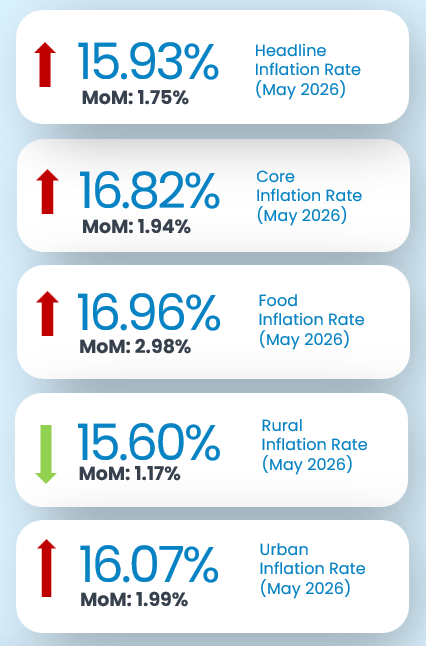
Headline inflation rose for the third consecutive month in May, increasing by 245bps to 15.93%. However, month-on-month inflation eased further to 1.75% from 2.13%, suggesting that while price levels continued to rise, the pace of increase moderated during the month.
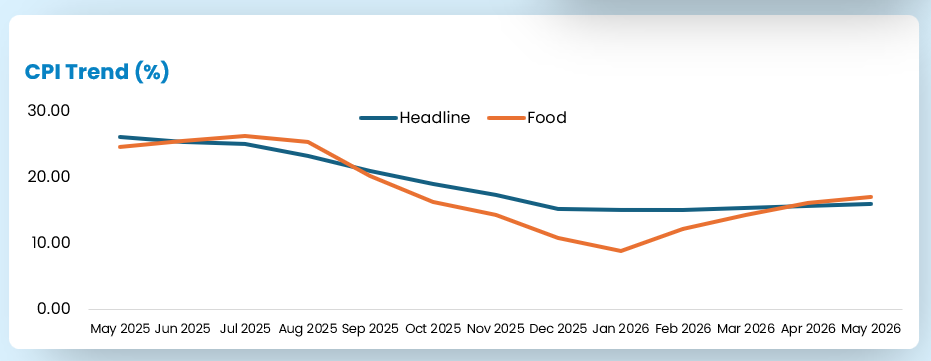
Food inflation rose to 16.96% YoY due to higher logistics costs and festive demand during Eid, but eased to 2.98% MoM, signaling slower food price growth. Core inflation stood out increasing Y-o-Y and M-o-M to 16.82%, to 1.94% respectively in June, showing that energy shocks transmit rapidly across core activities in the country.
The slowdown in monthly inflation signals a gradual easing of price pressures, a trend that could be further supported by improving global oil market conditions following the expected reopening of the Strait of Hormuz to crude shipments. Crude oil prices have declined from an average of $102.78/bbl in May to $79.85/bbl as of June 17, prompting Dangote Refinery to reduce its ex-depot PMS price toN1,175/litre. This is expected to lower retail fuel prices and gradually ease transportation and logistics costs, providing additional relief to inflationary pressures across the economy.
State Focus
Heightened insecurity in May did not translate to higher inflation in some states such as Niger, Borno, Katsina, Kogi, and Kebbi with headline Inflation below 13% and Food inflation below15% in May. However, Oyo stood out, reflecting the recent security incident with headline and food inflation rising to 18.69% and 19.10%, respectively.
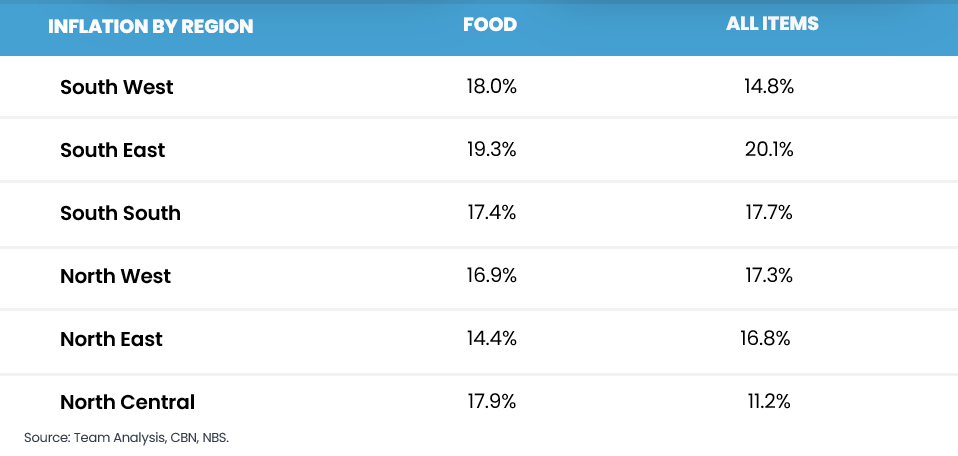
South-East recorded the highest regional food and all items inflation at 19.3% and 20.1%respectively in May while North Central had the lowest All-Item Inflation.
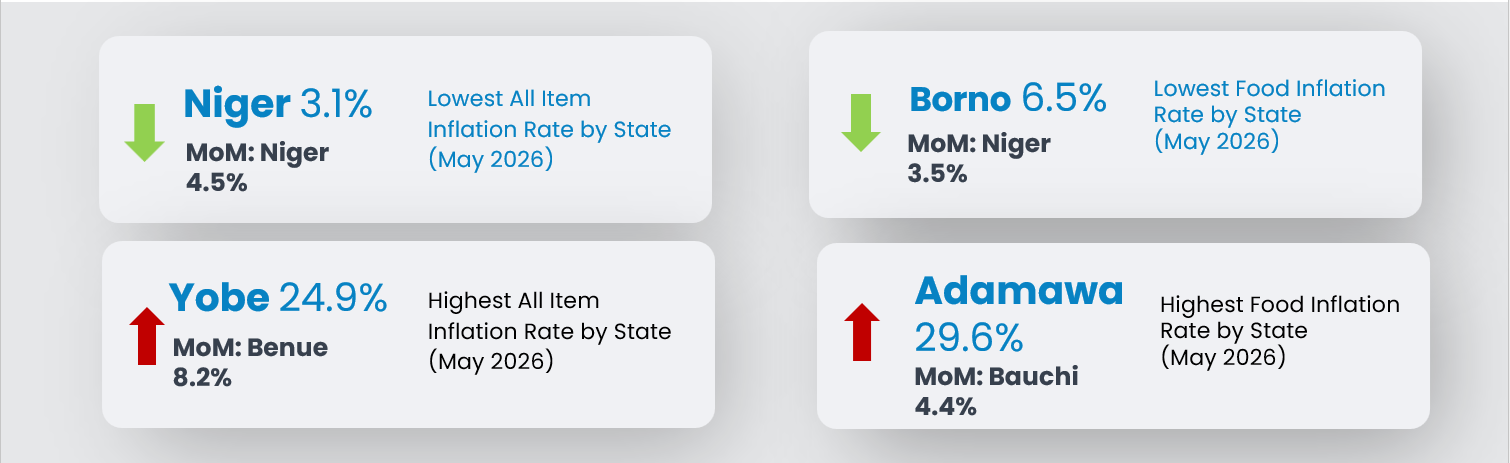
On a month-on-month basis, Benue (8.2%), Niger (4.5%), and Bauchi (4.4%) recorded the sharpest increases in headline inflation, while Borno (3.5%) and Niger (4.5%) also posted some of the strongest movements in food inflation during the month.
In food inflation, Adamawa (29.6%), Kwara (28.5%), and Rivers (28.4%) recorded the highest year-on-year readings, highlighting the continued impact of food supply constraints across key agricultural regions.
May Inflation Signals
The lingering U.S.–Iran conflict and temporary disruption to crude oil shipments through the Strait of Hormuz kept global oil prices elevated above US$100/bbl in May, exerting upward pressure on domestic energy costs and disrupting Nigeria's disinflation trend that had persisted since January 2025. Consequently, headline inflation rose for the third consecutive month, increasing to 15.93% YoY in May from 15.69% in April. Notably, both food inflation (16.96% YoY) and core inflation (16.82% YoY) exceeded headline inflation (15.93% YoY), despite headline inflation being the broadest measure of consumer prices. This divergence was largely driven by subdued energy prices, with monthly energy inflation slowing sharply to 0.72% in May from 8.00% in April. Given that food accounts for 40.1% of the CPI basket while housing, electricity, gas and other fuels account for 8.6%, the moderation in energy-related costs helped offset rising food and core prices, resulting in a lower headline inflation rate.
Core inflation increased to 16.82% YoY from 15.86% in April, while monthly core inflation accelerated to 1.94% from 1.03%. This was accompanied by services inflation of 17.92% YoY and 2.84% MoM, highlighting persistent price pressures across service-related sectors. Given that services account for nearly 58% of GDP and remain the largest contributor to economic activity, elevated inflation within the sector suggests that inflationary pressures are becoming increasingly broad-based beyond food-related factors.
State-level data also points to uneven inflation dynamics across the country. Yobe (24.94%), Anambra (23.29%) and Sokoto (22.60%) recorded the highest headline inflation rates, while Niger (3.07%), Plateau and Edo posted the lowest. For Food inflation, Adamawa, Kwara and Rivers recorded the highest readings, underscoring the continued impact of supply disruptions across key agricultural and distribution corridors.
The persistence of elevated inflation across several northern and food-producing states suggests that structural supply-side constraints remain a significant source of food price pressures.
Looking ahead, inflation would gradually moderate over the second half of 2026 if exchange rate stability persists, food supply conditions improve and recent decline in crude oil price are sustained.
In June, Inflation is expected to remain relatively sticky as security challenges across major agricultural belts continue to exert upward pressure on food prices. Although oil prices may gradually soften following the reopening of the Strait of Hormuz, supply-chain backlogs could delay the full pass-through of lower energy costs. As such, we expect headline inflation to print within the 15.89% - 15.91% range, before a more pronounced moderation emerges later in July.
June 2026 Outlook
The reversal of the US-Iran ceasefire deal could potentially trigger higher global oil prices. Additionally, the lean season and persistent insecurity are continuing to disrupt food supply chains, while flood alerts in some states could further intensify existing supply challenges.
On the other hand, lower expected landing costs for imported goods, due to the reduction in import duties on key commodities, could help ease import costs. Continued exchange rate stability could also help contain imported inflation and reduce pass-through from external price shocks. Furthermore, the recent decline in global crude oil prices, following the de-escalation of US-Iran tensions, may gradually ease pressure on fuel, transportation, and production costs.
Download the Full May 2026 Inflation Report
For detailed state-by-state breakdowns, technical analysis, and our June Outlook commentary, download the complete report.