




November marked a turning point in Nigeria’s foreign exchange market, breaking the naira’s seven-month run of steady appreciation. After months of gradual strengthening, the currency slipped at both the official and parallel markets, closing at ₦1,446.74/$ and ₦1,460/$ respectively by November 28. This mild depreciation, about 1.7% month-on-month, did not stem from domestic economic weakness, but rather from a mix of external and sentiment-driven pressures.
Two major triggers stood out. First, heightened geopolitical tensions emerged after President Trump made public comments suggesting possible U.S. security intervention in Nigeria. This unsettled investors and briefly clouded Nigeria’s risk outlook. Second, foreign investors began to unwind positions ahead of the January 2026 capital gains tax, prompting sizeable outflows, including ₦99.17bn in equity exits in October, the highest since March.
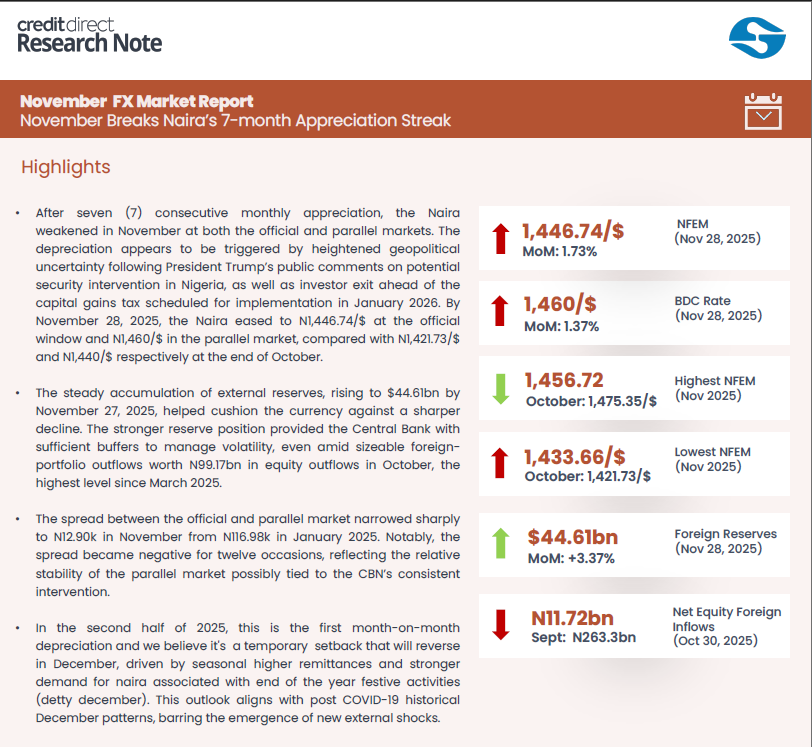
Despite these pressures, the market avoided a sharper decline because Nigeria’s external buffers strengthened significantly. Foreign reserves rose to $44.61bn by late November, their highest level in months. This gave the Central Bank of Nigeria enough room to stabilise the market through consistent interventions. As a result, the gap between official and parallel market rates narrowed drastically, from ₦116.98 in January to just ₦12.90 in November, even turning negative on some days.
The report views November’s depreciation as a temporary pause rather than the start of a downward trend. Historically, December brings stronger inflows from diaspora remittances and increased demand for naira due to festive spending. Combined with the CBN’s ongoing interventions and the country’s improving reserve position, the outlook suggests the naira could regain some strength in December.
However, risks remain. Oil prices, the backbone of FX earnings, are still vulnerable to global volatility. Security concerns and incoming tax changes may continue to influence investor behaviour. On the positive side, expanding naira-yuan swap activity, peer-to-peer trade, and stable oil prices above $60/b offer some support.
Overall, the November FX movement matters because it reflects how quickly sentiment and external events can shift market direction, even when key fundamentals are improving. With steady reserves and seasonal inflows, the path into December appears cautiously optimistic.
Download the full report free to explore detailed insights and sectoral data.